1

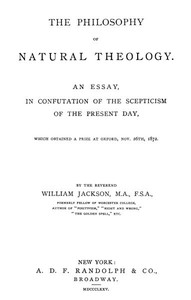
The Philosophy of Natural Theology An Essay in confutation of the scepticism of the present day — Inside the Classic
2713
2
Project Gutenberg
2014
Religion and science; Natural theology; Religion -- Philosophy
Readers of public-domain and historical texts
Project Gutenberg digital edition
en
Edition facts
Words: 166,330
Reading time: 724 min
Text sections: 22
Source:
Project Gutenberg record #47314
An 1872 Oxford prize essay confuting materialism through arguments from design, intelligence, and moral nature, structured as a philosophical disputation with recurring attention to the soul as a test of materialism.
Editorial Edition Score
4.9/5
★★★★★
★★★★★
Calculated from edition completeness, EPUB availability, text structure and catalogue metadata. Not a user rating.
Edition quality
The essay opens by framing its central test of materialism not in terms of matter versus spirit, but in the doctrine of the soul: 'the readiest test of moral or religious Materialism is its doctrine, not of Body but of Soul.' This inversion of expected categories sets the tone for a work that repeatedly moves between abstract philosophical argument and concrete appeals to human experience. The author, William Jackson, positions himself against the 'scepticism of the present day' by engaging with contemporary thinkers such as Herbert Spencer and T.H. Huxley, quoting Huxley's repudiation of necessity as 'an empty shadow of my own mind's throwing.' The essay's structure follows a prize competition rubric that demanded arguments independent of Hegelian spiritual philosophy, grounding its case in evidences of intelligence, design, and adaptation in the universe and in man.
The Prize Context and Argumentative Framework
The essay originated from a £100 prize offered in 1870 by an anonymous donor, to be judged by the Dean of St. Paul's, the Regius Professor of Divinity, and the Savilian Professor of Astronomy. The competition required confuting materialism using arguments from 'Evidences of Intelligence, Design, Contrivance, and Adaptation of Means to Ends' in the universe and in man's moral nature, religious aptitudes, and intellectual powers. Notably, the rubric explicitly excluded arguments derived from Hegel and German spiritual philosophy. Jackson's response adheres to this constraint, focusing instead on empirical and logical reasoning. The essay's structure reflects this mandate: it moves from general principles to specific applications, with recurring attention to the concept of law and necessity. The author distinguishes between physical law as observed regularity and the illegitimate introduction of necessity, following Huxley's lead. This framework allows Jackson to argue that materialism conflates description with compulsion.
Recurring Images of Law and Necessity
A persistent image in the essay is that of law—both physical and moral. Jackson contrasts the 'iron law' of gravitation with the freedom of human will, quoting Huxley's assertion that necessity is 'an empty shadow of my own mind's throwing.' The author repeatedly returns to the distinction between 'is' and 'must,' arguing that materialism illegitimately transforms observed regularities into metaphysical necessities. This image of law as a shadow or intruder recurs throughout the excerpts, suggesting a structural pattern: Jackson first presents the materialist claim, then dissects its logical leap from fact to necessity. The essay also introduces the term 'Abiology' for the lifeless inorganic world, contrasting it with the realm of living beings. This binary—between the mechanical and the organic, the determined and the self-legislating—structures much of the argument. The reader is invited to see the materialist worldview as one that collapses these distinctions, while natural theology restores them.
Movement Between Abstract and Concrete
Jackson's essay moves fluidly between abstract philosophical analysis and concrete appeals to human experience. For instance, after a dense discussion of determinism and the 'hybrid class of thinkers' who are neither pure physicists nor pure metaphysicians, he suddenly addresses the reader directly: 'Eyes that have watched for Righteousness, hearts that have yearned after it, let the answer come from you!' This shift from third-person argument to second-person invocation is a recurring structural device. It serves to ground the abstract debate in lived moral and religious sentiment. Similarly, the author uses the image of a 'Debateable Land' to characterize thinkers who straddle physics and metaphysics, a metaphor that evokes a geographical border zone. These movements between registers—from logical dissection to rhetorical appeal, from technical terminology to vivid metaphor—create a rhythm that keeps the reader engaged while advancing the confutation. The essay does not remain in the realm of pure theory but repeatedly returns to the stakes for human hope and belief.
The Soul as Central Test
Jackson explicitly identifies the doctrine of the soul as the decisive criterion for distinguishing materialism from natural theology. He writes that 'the readiest test of moral or religious Materialism is its doctrine, not of Body but of Soul.' This claim is supported by a careful distinction: materialism is not defined by belief in matter, but by whether man is 'mechanically governed by the Law which rules the world of Abiology' or can become 'a Law unto himself.' The essay thus reframes the debate away from cosmology and toward anthropology. The author argues that physical science per se is not responsible for ethico-religious materialism; rather, the chief offenders are metaphysical writers. This move allows Jackson to engage with scientific authorities like Huxley and Spencer while maintaining that the real issue is human freedom and moral accountability. The recurring image of the soul as a test—almost a litmus—gives the essay a clear focal point, around which the arguments about design, intelligence, and adaptation are organized.
Readers approaching this essay should attend to its dual movement: the logical dissection of materialist arguments and the rhetorical appeals to moral experience. Jackson's method is not merely to refute but to reorient the reader's attention from matter to soul, from necessity to freedom. The essay rewards those who follow its structural cues—the recurring images of law, the shifts between abstract and concrete, and the central test of the soul. It is a work of philosophical disputation that remains grounded in the specific terms of its 1872 prize competition, yet its questions about the relationship between science, morality, and belief retain relevance.
Reader reflection
How did this book work for you?
Your answers remain private and are stored only in this browser.
Your progress
0
/
10
2
How much did you enjoy the reading experience?
3
Would you pass this book on to a friend?
4
Did the language feel accessible?
5
How personally connected did you feel to the book?
6
How did the pace of the book feel?
7
Did you gain anything practical from the text?
8
Did this book create an emotional response?
9
What is the main idea you are taking away?
10