1

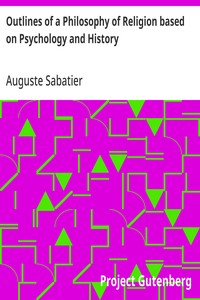
Outlines of a Philosophy of Religion based on Psychology and History — Edition Insights
24
4
Project Gutenberg
2011
Religion -- Philosophy; Christianity -- Philosophy; Dogma
Readers of public-domain and historical texts
Project Gutenberg digital edition
en
Edition facts
Words: 76,344
Reading time: 332 min
Text sections: 9
Source:
Project Gutenberg record #38446
Sabatier applies psychological and historical methods to religion, tracing Christianity through three forms—Jewish, Catholic, Protestant—and analyzing dogma as a living, evolving expression of religious experience, not static truth.
Editorial Edition Score
4.7/5
★★★★★
★★★★★
Calculated from edition completeness, EPUB availability, text structure and catalogue metadata. Not a user rating.
Edition quality
Sabatier opens his preface with an architectural metaphor: the three parts of his work are 'the three stories of one and the same edifice.' He moves from the general (religion’s psychological origin) to the particular (Christianity’s essence) to the doctrinal (dogma’s nature). This structure is not arbitrary; it reflects his method of 'strictly psychological and historical observation,' which he claims to have applied for years. The reader is immediately placed in a framework that prioritizes empirical study over abstract system-building.
Sabatier explicitly warns against identifying any particular church or dogma with Christianity itself. He insists that 'perfection is nowhere to be found' and that the habit of putting 'all the truth on our side and all error on the side of others' falsifies judgment and sours piety. This sets a critical, self-reflective tone that pervades the entire work.
The Three-Story Edifice: Method and Structure
Sabatier’s preface presents his work as a unified structure with three distinct but connected levels. Book I treats religion and its origin; Book II, Christianity and its essence; Book III, dogma and its nature. He insists this is not a system but the 'rigid application' of psychological and historical observation. The metaphor of an edifice suggests both coherence and progression: each story depends on the one below. The reader should note that Sabatier repeatedly emphasizes method over conclusion, positioning himself as an observer rather than a dogmatist.
He also acknowledges the vastness of the field: 'The field is vast; the vegetation in it is infinite; we must content ourselves with incompleteness.' This humility is a recurring posture, contrasting with the confident architectural image. The tension between systematic ambition and methodological restraint is a key feature of the work’s opening.
Christianity as Leaven: The Principle of Transformation
Sabatier defines the Christian principle as 'like leaven or a seed thrown into a gross, heavy mass of anterior traditions.' This organic metaphor drives his historical analysis. Christianity, he argues, borrows forms from its environment, endures them, then frees itself and manifests 'a greater independence and a purer and higher spirituality.' Progress is slow, interrupted, but measurable when one compares points of departure and arrival.
He identifies three distinct historical forms: Jewish or Messianic, Graeco-Roman or Catholic, and Protestant or modern. This tripartite scheme is central to his argument. Notably, he criticizes both Catholic and Protestant theologians for distorting early Christian history—Catholics by projecting later institutions onto the apostolic age, Protestants by treating the New Testament as verbally inspired and thus flattening historical development.
Dogma in Motion: The Life and Crisis of Doctrines
In Book III, Sabatier turns to dogma, which he treats not as fixed truth but as a living phenomenon with a genesis, role, and evolution. He identifies 'three prejudices' that hinder understanding of dogma’s life, and distinguishes two elements within dogma—one permanent, one temporary. The 'crisis of dogma' arises when the temporary forms no longer contain the religious experience they once expressed.
Sabatier’s approach is explicitly Kantian in its epistemology: he distinguishes two orders of knowledge and emphasizes the subjectivity of religious knowledge. His conclusion invokes 'symbolism' as the mode of religious expression. The appendix, 'Reply to Criticisms,' suggests that this work was itself part of an ongoing debate, reinforcing the idea that Sabatier saw his own writing as provisional and engaged.
Sabatier’s work is best approached as a sustained argument for a method rather than a finished system. Readers will benefit from tracking his use of organic metaphors (seed, leaven, vegetation) and architectural ones (edifice, stories), which together convey both growth and structure. The frequent self-corrections and warnings against complacency invite the reader into a critical dialogue, not passive reception. Pay attention to how Sabatier handles the tension between the universal and the particular—this is the engine of his philosophy.
Reader reflection
How did this book work for you?
Your answers remain private and are stored only in this browser.
Your progress
0
/
10
2
Did this book hold your interest?
3
Is this a title you would suggest to others?
4
How much effort did this book require?
5
Is this a title worth rereading?
6
How closely did the book connect with your experience?
7
How did the reading compare with what you expected?
8
How valuable was this book for your own interests?
9
In one sentence, what did you learn?
10