1

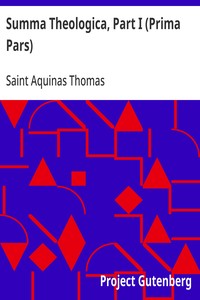
Summa Theologica, Part I (Prima Pars) From the Complete American Edition — Themes and Context
279
2
Project Gutenberg
2006
Theology, Doctrinal -- Early works to 1800; Catholic Church -- Doctrines -- Early works to 1800; God -- Omnipresence -- Early works to 1800; God -- Attributes -- Early works to 1800
Readers of public-domain and historical texts
Project Gutenberg digital edition
en
Edition facts
Words: 495,424
Reading time: 2155 min
Text sections: 41
Source:
Project Gutenberg record #17611
Editorial note examining how Aquinas's Summa Theologica, Part I, uses Aristotelian philosophy to structure arguments about angelic will, with attention to the translation's formatting choices and the relationship between catalog subjects and actual content.
Editorial Edition Score
4.9/5
★★★★★
★★★★★
Calculated from edition completeness, EPUB availability, text structure and catalogue metadata. Not a user rating.
Edition quality
The Summa Theologica, Part I opens not with a general statement about God but with a tightly structured inquiry into the nature of angels, specifically their will. The excerpt from Question 59 reveals a method: Aquinas poses objections, cites authorities (Aristotle, Augustine), then gives a formal answer. The translation by the Fathers of the English Dominican Province preserves this scholastic architecture, including numbered objections and replies. The catalog subjects list “God – Omnipresence” and “God – Attributes,” yet the sample text focuses on angelic cognition and appetite, showing that the work’s scope extends well beyond those headings.
Aristotle as Structural Backbone
Aquinas repeatedly invokes “the Philosopher” (Aristotle) to frame his arguments. In Question 59, Article 1, the first objection cites Aristotle’s De Anima to claim that will resides in reason, which angels lack. The reply does not reject Aristotle but reinterprets him: angels have a higher faculty than reason, yet will is present. This pattern—objection from Aristotle, answer that refines rather than discards—appears throughout. The translation signals these references with parentheses and italicized titles, such as “(De Anima iii, text. 42).” Readers should note that the Summa is not a purely theological work; it is a philosophical dialogue with Aristotelian categories.
Formatting as a Window into Transmission
The electronic edition includes a detailed note by David McClamrock explaining changes from the Benziger Brothers print edition. For instance, the repetitive phrase “We proceed thus to the [next] Article” was removed, and Bible citations use arabic numerals (e.g., “Dan. 7:10”) instead of roman. Italics are represented by underscores, and footnotes appear inline in brackets. These choices affect readability: the text is cleaner but loses some visual cues of the original. One correction is highlighted: in Question 45, Article 2, the word “[not]” was inserted to fix a probable error. Such editorial interventions remind us that the Summa we read is a constructed text, not a direct transcript of Aquinas’s manuscript.
Angelic Will and the Limits of the Excerpts
The excerpt covers only the first article of Question 59, which asks “Whether There Is Will in the Angels?” Aquinas answers affirmatively, distinguishing natural, sensitive, and intellectual appetite. But the text breaks off before the second article, which asks whether the angel’s will is its nature or its intellect. The catalog subjects list “Theology, Doctrinal” and “Catholic Church – Doctrines,” yet the sample is a metaphysical inquiry into appetite and knowledge, not a doctrinal statement. Readers should be cautious: the excerpts do not show how Aquinas connects angelic will to broader theological topics like grace or sin. The work’s 495,424 words cover far more than these few pages suggest.
This edition’s formatting choices—removed repetitive headings, inline footnotes, and corrected errors—make the text more accessible but also alter its original rhythm. Readers interested in the Summa as a historical document may wish to compare this version with a facsimile of the Benziger Brothers print. The excerpts here offer a narrow but precise view of Aquinas’s method: a blend of Aristotelian logic, patristic authority, and systematic questioning that defines the work’s character.
Reader reflection
Before you leave, reflect on the book
Use these questions to collect your thoughts before moving on.
Your progress
0
/
10
2
What was your overall reaction to the book?
3
Would you recommend this book to another reader?
4
How easy was the book to follow?
5
What did you appreciate most?
6
Would you start a conversation about this book?
7
Did any part of the book stay with you emotionally?
8
How did the reading compare with what you expected?
9
Which lesson or insight stayed with you?
10