1

The Analogy of Religion to the Constitution and Course of Nature To which are added two brief dissertations: I. On personal identity. II. On the nature of virtue. — Background and Themes
23
10
Project Gutenberg
2016
Revelation; Natural theology; Apologetics -- Early works to 1800; Eschatology; Analogy (Religion)
Readers of public-domain and historical texts
Project Gutenberg digital edition
en
Edition facts
Words: 145,787
Reading time: 634 min
Text sections: 18
Source:
Project Gutenberg record #53346
Butler's 1736 work argues that objections to Christianity parallel difficulties in nature, using analogy to defend natural and revealed religion. This edition includes editor Howard Malcolm's introduction, notes, conspectus, and indexes.
Editorial Edition Score
4.8/5
★★★★★
★★★★★
Calculated from edition completeness, EPUB availability, text structure and catalogue metadata. Not a user rating.
Edition quality
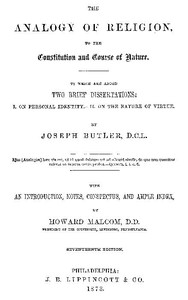
Joseph Butler's The Analogy of Religion opens with a striking epigraph from Quintilian: analogy's force is to refer what is doubtful to something similar about which there is no question, proving uncertain things by certain ones. This methodological statement sets the tone for a work that systematically compares the constitution and course of nature to the claims of religion. The 1873 edition, edited by Howard Malcolm, includes a detailed conspectus and extensive indexes, framing Butler's arguments for a nineteenth-century readership. The text is divided into two parts: natural religion and revealed religion, each with chapters addressing future life, divine government, probation, and the credibility of revelation.
The Opening Framework: Epigraph and Editor's Apparatus
The epigraph from Quintilian, printed on the title page, is not decorative but programmatic. It announces Butler's central method: using analogies from nature—which readers accept as given—to argue for religious doctrines that might otherwise seem improbable. The editor, Howard Malcolm, reinforces this by providing a conspectus that outlines the logical structure of the work, making it easier to follow Butler's chain of reasoning. Malcolm's introduction also offers biographical context, noting that Butler was born in 1692 and that few details of his life survive. This editorial apparatus suggests that the book was intended for serious study, perhaps in academic or clerical settings.
Butler's Argumentative Voice: Reasoned and Cautious
Butler's prose is measured and careful, often qualifying his claims. For example, in the excerpt discussing mercy and sacrifice, he writes that the determination is general because the manner of speaking renders it so, and he insists that the obligation to obey divine commands is absolute. He also warns against the human tendency to undervalue lesser institutions when comparing them to greater ones. This cautious, almost legalistic tone pervades the work, as Butler builds his case step by step, anticipating objections and addressing them with analogies from everyday experience. The reader should expect a dense, logical argument rather than rhetorical flourish.
Key Structural Feature: The Two-Part Division
The book is divided into two parts: natural religion and revealed religion. Part I covers topics such as a future life, divine government, and probation, while Part II addresses the importance of Christianity, the presumption against miracles, and the evidence for revelation. This structure mirrors Butler's analogical method: he first establishes the principles of natural religion from the observed course of nature, then applies those same principles to defend revealed religion. The chapters are further subdivided, with each building on the previous. The inclusion of two dissertations—on personal identity and the nature of virtue—extends the argument into philosophical territory.
Reading with the Editor's Aids: Conspectus and Indexes
Howard Malcolm's edition includes a conspectus that summarizes each chapter's argument, as well as indexes to both parts. These tools are invaluable for navigating Butler's lengthy and intricate reasoning. The conspectus, placed after the editor's introduction, provides a bird's-eye view of the entire work, allowing readers to see how each chapter contributes to the overall argument. The indexes list key terms and concepts, making it easier to locate specific discussions. For a first reading, it may be helpful to consult the conspectus before each chapter to grasp the main points, then read the chapter itself to follow Butler's detailed reasoning.
Butler's Analogy rewards patient reading. The editor's apparatus—conspectus, notes, and indexes—is designed to aid comprehension, but the core of the work lies in Butler's own careful comparisons between nature and religion. Readers should pay attention to how he uses everyday examples to illuminate theological claims, and how he anticipates and counters objections. The two dissertations at the end offer further philosophical reflection on identity and virtue, complementing the main argument.
Reader reflection
How did this book work for you?
Your answers remain private and are stored only in this browser.
Your progress
0
/
10
2
How much did you enjoy the reading experience?
3
Would you pass this book on to a friend?
4
How demanding did the text feel?
5
Did the book deliver what you hoped for?
6
Did anything about the book feel genuinely new?
7
Could you follow the author’s main argument?
8
What did you think about the pace?
9
What is the main idea you are taking away?
10