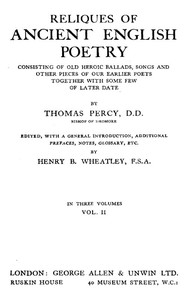
Reliques of Ancient English Poetry, Volume 2 (of 3) by Percy and Wheatley

(9 User reviews)   2301
English
Ever wondered what stories your great-great-great-grandparents told around the fire? Forget dusty history books—this collection is the real deal. It's a time capsule of ballads, songs, and poems rescued from taverns, village storytellers, and handwritten manuscripts that were almost lost forever. We're talking about tales of Robin Hood, tragic love stories, ghostly encounters, and bawdy humor that regular folks actually enjoyed for centuries. It's raw, surprising, and sometimes downright weird. Think of it as finding your country's old, forgotten playlist. If you like history with a pulse and stories that feel alive, you need to check this out.
Share

Read "Reliques of Ancient English Poetry, Volume 2 (of 3) by Percy and Wheatley" Online

This book is available in the public domain. Start reading the digital edition below.

START READING FULL BOOK
Instant Access    Mobile Friendly

Book Preview

A short preview of the book’s content is shown below to give you an idea of its style and themes.

kings and princes at pleasure, is a privilege of very long standing. To render this antique libel intelligible, the reader is to understand that just before the battle of Lewes, which proved so fatal to the interests of Henry III., the barons had offered his brother Richard, King of the Romans, 30,000_l._ to procure a peace upon such terms, as would have divested Henry of all his regal power, and therefore the treaty proved abortive. The consequences of that battle are well-known: the king, prince Edward his son, his brother Richard, and many of his friends, fell into the hands of their enemies: while two great barons of the king's party, John, Earl of Warren, and Hugh Bigot, the king's justiciary, had been glad to escape into France. In the first stanza the aforesaid sum of thirty thousand pounds is alluded to, but with the usual misrepresentation of party malevolence, is asserted to have been the exorbitant demand of the king's brother. With regard to the second stanza the reader is to note that Richard, along with the earldom of Cornwall, had the honours of Walingford and Eyre confirmed to him on his marriage with Sanchia, daughter of the Count of Provence, in 1243. Windsor Castle was the chief fortress belonging to the king, and had been garrisoned by foreigners: a circumstance which furnishes out the burthen of each stanza. The third stanza alludes to a remarkable circumstance which happened on the day of the battle of Lewes. After the battle was lost, Richard, king of the Romans, took refuge in a windmill, which he barricaded, and maintained for some time against the barons, but in the evening was obliged to surrender. See a very full account of this in the _Chronicle of Mailros_, Oxon. 1684, p. 229.[1] The fourth stanza is of obvious interpretation: Richard, who had been elected king of the Romans in 1256, and had afterwards gone over to take possession of his dignity, was in the year 1259 about to return into England, when the barons raised a popular clamour, that he was bringing with him foreigners to over-run the kingdom: upon which he was forced to dismiss almost all his followers, otherwise the barons would have opposed his landing. In the fifth stanza the writer regrets the escape of the Earl of Warren, and in the sixth and seventh stanzas insinuates that if he and Sir Hugh Bigot once fell into the hands of their adversaries, they should never more return home; a circumstance which fixes the date of this ballad, for, in the year 1265, both these noblemen landed in South Wales, and the royal party soon after gained the ascendant. See Holinshed, Rapin, &c. The following is copied from a very ancient MS. in the British Museum. (Hart. MSS. 2253, fol. 58 v°.) This MS. is judged, from the peculiarities of the writing, to be not later than the time of Richard II.; _th_ being everywhere expressed by the character þ; the _y_ is pointed after the Saxon manner, and the _i_ hath an oblique stroke over it. * * * * * [The date of the MS. in which this ballad occurs is usually placed at an earlier period than that fixed upon by Percy. Mr. Thomas Wright, who prints it in his volume of _Political Songs of_ _England_ (Camden Society), with several other poems in French, Anglo-Norman, and Latin, on Simon de Montfort and the Barons' Wars, assigns it to the reign of Edward II. It will be seen from Percy's note to verse 44, that the last stanza was printed...

This is a limited preview. Download the book to read the full content.

Okay, so this isn't a novel with a single plot. 'Reliques of Ancient English Poetry' is more like a treasure hunt through time. Bishop Thomas Percy basically found a bunch of old, crumbling papers in a friend's house—manuscripts full of songs and poems that were about to be used as kindling for the fire! He saved them, and this book (Volume 2 of 3) is the result. It's his collection of these rescued pieces, edited by Henry Wheatley. You'll find everything from epic ballads about knights and kings to funny, simple songs about farmers and love gone wrong.

The Story

There's no one story. Instead, you open a door to hundreds of them. One page has a haunting ballad about a woman betrayed and turned into a ghost. The next might have a rousing song about outlaws stealing from the rich. Then you'll flip to a silly, rhyming tale that would have had a whole pub laughing. The 'conflict' is the fight against time itself—these are the stories that survived by word of mouth and luck, giving us a direct line to what everyday people found thrilling, sad, or hilarious long before novels existed.

Why You Should Read It

Reading this feels like discovering a secret history. The language is beautiful and rhythmic, but also surprisingly direct. These aren't fancy poems for scholars; they're stories with guts and heart. You get a real sense of the humor, fears, and dreams of regular people from another age. It completely shatters the idea that the past was all stiff formality. Some of these ballads are as gripping and emotional as any modern short story.

Final Verdict

Perfect for curious readers who love history, folklore, or songwriting. If you're a fan of shows like 'The Witcher' or books that draw on old myths, this is the source material. It's also great for dipping in and out of—read a ballad or two before bed. Just be ready for spellings like 'olde' and some archaic words (the notes help a lot!). This is for anyone who wants to hear the actual voice of the past, unfiltered and full of life.


✅ No Rights Reserved

No rights are reserved for this publication. Share knowledge freely with the world.

Jennifer Miller
1 year ago

Thanks for the recommendation.

Margaret Jackson
11 months ago

Comprehensive and well-researched.

Liam Flores
1 year ago

The layout is very easy on the eyes.

Kimberly Hill
1 year ago

After finishing this book, the depth of research presented here is truly commendable. Exceeded all my expectations.

Mary Gonzalez
2 months ago

I didn't expect much, but it manages to explain difficult concepts in plain English. One of the best books I've read this year.

5
5 out of 5 (9 User reviews )

Add a Review

Your Rating *
There are no comments for this eBook.
You must log in to post a comment.
Log in


Related eBooks