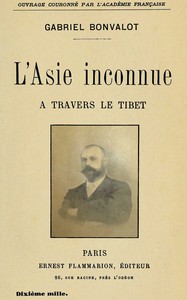
L'Asie inconnue : à travers le Tibet by Gabriel Bonvalot

(5 User reviews)   2901
Bonvalot, Gabriel, 1853-1933 Bonvalot, Gabriel, 1853-1933
French
Hey, have you ever wanted to read something that feels like a real-life adventure novel? I just finished Gabriel Bonvalot's 'L'Asie inconnue,' and it's wild. Imagine this: in the late 1800s, this French explorer decides to walk across the heart of Asia, through the forbidden and mysterious Tibetan plateau. It wasn't a pleasure trip. He faced closed borders, suspicious officials, and some of the most extreme landscapes on Earth. The whole book is this tense, incredible story of trying to get somewhere you're not supposed to be. It’s less about grand discoveries and more about the sheer, stubborn will to keep moving forward against impossible odds. If you like true stories of exploration where the journey itself is the main character, you have to check this out.
Share

Read "L'Asie inconnue : à travers le Tibet by Gabriel Bonvalot" Online

This book is available in the public domain. Start reading the digital edition below.

START READING FULL BOOK
Instant Access    Mobile Friendly

Book Preview

A short preview of the book’s content is shown below to give you an idea of its style and themes.

d’être sur le terrain, il est enfantin et inutile de rien affirmer. Les premiers préparatifs ayant été rapidement terminés, le 6 juillet nous quittions Paris enfiévré alors de son Exposition. A Moscou nous devions rencontrer Rachmed, le fidèle compagnon de mes deux précédents voyages. On me l’avait trouvé au Caucase à l’endroit où je supposais qu’il serait, car je sais près de quelles gens Rachmed aime à vivre, quand il ne court pas les grands chemins. Le brave garçon se préparait à venir à l’Exposition, il réalisait un rêve qu’il caressait depuis longtemps; déjà son billet était pris, il allait s’embarquer à Batoum, lorsque mon télégramme lui parvint: «Si tu veux venir Chine avec moi, va attendre Moscou.» Et Rachmed alla aux bureaux de la compagnie Paquet se faire rembourser son billet de Paris et il en prit un autre pour Moscou. Il n’était pas heureux de la conjoncture; comme vous pensez bien, il avait le cœur gros de ne pas voir l’Exposition. Pourtant il n’hésita pas. Ainsi qu’il le confia, en parlant de moi, à un de mes amis, il avait la crainte de perdre mon affection: «Il n’aurait pas été content», disait-il. Rachmed est Ousbeg d’origine, il appartient à une des branches de cette belle race turque où l’on compte tant de braves gens, je ne me lasserai jamais de le répéter. En Russie on nous fait le meilleur accueil. On nous donne toutes les recommandations nécessaires pour les consuls de la frontière chinoise. A Moscou nous séjournons juste le temps de faire d’innombrables achats. Nous touchons à Nijnii-Novgorod, nous descendons le Volga, remontons la Kama, traversons la chaîne de l’Oural. Nous reprenons le bateau à Tioumen, débarquons à Omsk et, y ayant fait quelques emplettes, nous repartons pour Semipalatinsk. Là nous achetons les produits européens que nous craignons de ne pouvoir nous procurer à l’extrême frontière, et, à grands cahots de _tarantass_, nous arrivons à Djarkent, la dernière ville du territoire russe. * * * * * Avant d’entrer en Chine nous organisons notre caravane et nous recrutons le personnel nécessaire à l’exécution de nos projets. Rachmed examine les hommes, et, en me les présentant, il me dit invariablement: «Ils ne valent rien pour la route.» Je vois bien qu’il a raison. Pas un seul qui ait un passé sérieux: tous des paresseux, des endettés, des gens qui veulent passer la frontière dans notre suite; aucun de ces bons aventuriers à mine décidée, vigoureux, ayant déjà regardé la mort sous le nez, et qui suivraient dans le feu le chef que le hasard leur donne, pourvu que ce chef ait su se les attacher par un mélange parfois égal de bons et de mauvais traitements. Combien nous regrettons de n’avoir pas notre base d’opérations dans le Turkestan russe, à Samarcande, par exemple, où les bons _djiguites_ ne manquent pas. Nous avons bien trois Russes qui nous conviendraient, mais ils ont posé comme condition d’engagement de ne pas dépasser le Lob Nor. Le 2 septembre nous quittons Djarkent. En marchant à petites journées, nous sommes, le 6, à Kouldja, où le consul russe et son secrétaire nous offrent la plus cordiale hospitalité. Nous passons de bons moments chez les membres de la mission belge. L’un d’eux, le Père Dedeken, a terminé son engagement: il doit retourner en Europe, et, comme il a un rendez-vous à Chang-haï, il s’en ira à la Côte avec nous et peut-être nous accompagnera en Europe. Le Père parle chinois. C’est un homme décidé, et nous sommes heureux de le voir grossir notre troupe. Son serviteur, Bartholomeus, l’accompagnera. C’est un Chinois honnête, chose extrêmement...

This is a limited preview. Download the book to read the full content.

Published in 1896, L'Asie inconnue is Gabriel Bonvalot's firsthand account of his 1889-1890 expedition. His goal was deceptively simple: to cross from Siberia, through the heart of Tibet, and down into what was then French Indochina (modern-day Vietnam). The problem? Tibet was a closed kingdom, fiercely protective of its isolation. European maps of the region were mostly blank, filled with guesswork and legend.

The Story

Bonvalot's journey reads like a high-stakes puzzle. It’s not just about surviving the brutal cold of the high passes or the endless, empty plains. The real challenge is human. He has to negotiate with local rulers who don't want him there, avoid Chinese authorities who could turn him back, and rely on guides who are often just as lost as he is. The narrative is a day-by-day grind of small victories and constant setbacks—finding a pass, securing supplies, convincing a village to let him through. The ‘unknown Asia’ he writes about feels less like a place of hidden treasures and more like a vast, bureaucratic and geographical maze.

Why You Should Read It

What grabbed me was the raw, unfiltered perspective. This isn't a polished, romantic tale of empire. You feel Bonvalot's frustration, his exhaustion, and his genuine awe at the landscapes. He describes cultures and places with a curiosity that, for its time, feels more observational than judgmental. The book’s power comes from its immediacy. You’re right there with him, wondering if the next valley will offer shelter or another dead end.

Final Verdict

This is a perfect pick for readers who love real adventure and armchair travel. If you enjoy the works of later explorers like Peter Fleming or classic expedition journals, you’ll feel right at home. It’s also a fascinating glimpse into a world right before it changed forever. Just be ready for a story where the greatest enemy isn't a wild animal, but a locked door on the map.


🟢 No Rights Reserved

This title is part of the public domain archive. It is now common property for all to enjoy.

Thomas Martinez
2 years ago

Finally a version with clear text and no errors.

Donna Martin
1 year ago

I started reading out of curiosity and the atmosphere created is totally immersive. This story will stay with me.

Christopher Torres
1 month ago

Great read!

Jackson Taylor
1 year ago

Great reference material for my coursework.

Karen Allen
1 year ago

I was skeptical at first, but the storytelling feels authentic and emotionally grounded. Highly recommended.

4
4 out of 5 (5 User reviews )

Add a Review

Your Rating *
There are no comments for this eBook.
You must log in to post a comment.
Log in


Related eBooks