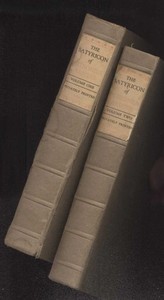
The Satyricon — Complete by Petronius Arbiter

(2 User reviews)   3202
Petronius Arbiter, 20-66 Petronius Arbiter, 20-66
English
Ever wonder what really happened at Roman dinner parties? 'The Satyricon' is your backstage pass to the wildest, most outrageous slice of ancient life you'll ever read. Forget the marble statues and noble speeches—this book follows two broke, horny students, Encolpius and Ascyltus, as they lie, cheat, and stumble through a world of gluttonous millionaires, shady poets, and chaotic street fights. The main thing driving them? They've seriously ticked off Priapus, the god of, well, virility, and he's cursed Encolpius with a very specific and embarrassing problem. It's a hilarious, raunchy, and surprisingly modern adventure about trying to get by in a society obsessed with wealth and status.
Share

Read "The Satyricon — Complete by Petronius Arbiter" Online

This book is available in the public domain. Start reading the digital edition below.

START READING FULL BOOK
Instant Access    Mobile Friendly

Book Preview

A short preview of the book’s content is shown below to give you an idea of its style and themes.

authorship of the work and the very age in which the composer flourished. To me, personally, the fact that Laurence Sterne did not undertake a version, has caused much regret. The master who delineated Tristram Shandy’s father and the intrigue between the Widow Wadman and Uncle Toby would have drawn Trimalchio and his peers to admiration. W. C. F. CONTENTS: PREFACE INTRODUCTION THE SATYRICON NOTES PROSTITUTION PAEDERASTIA CHAPTER NOTES 9 Gladiator obscene 17 Impotence 26 Peepholes in brothels 34 Silver Skeleton 36 Marsyas 40 A pie full of birds 56 Contumelia 116 Life in Rome 116 Legacy hunting 119 Castration 127 Circe’s voice 131 Sputum in charms 131 The “infamous finger” 138 The dildo The Cordax SIX NOTES BY MARCHENA Introduction I Soldiers in love II Courtesans III Greek love IV Pollution V Virginity VI Pandars INTRODUCTION. Of the many masterpieces which classical antiquity has bequeathed to modern times, few have attained, at intervals, to such popularity; few have so gripped the interest of scholars and men of letters, as has this scintillating miscellany known as the Satyricon, ascribed by tradition to that Petronius who, at the court of Nero, acted as arbiter of elegance and dictator of fashion. The flashing wit, the masterly touches which bring out the characters with all the detail of a fine old copper etching; the marvelous use of realism by this, its first prophet; the sure knowledge of the perspective and background best adapted to each episode; the racy style, so smooth, so elegant, so simple when the educated are speaking, beguile the reader and blind him, at first, to the many discrepancies and incoherences with which the text, as we have it, is marred. The more one concentrates upon this author, the more apparent these faults become and the more one regrets the lacunae in the text. Notwithstanding numerous articles which deal with this work, some from the pens of the most profound scholars, its author is still shrouded in the mists of uncertainty and conjecture. He is as impersonal as Shakespeare, as aloof as Flaubert, in the opinion of Charles Whibley, and, it may be added, as genial as Rabelais; an enigmatic genius whose secret will never be laid bare with the resources at our present command. As I am not writing for scholars, I do not intend going very deeply into the labyrinth of critical controversy which surrounds the author and the work, but I shall deal with a few of the questions which, if properly understood, will enhance the value of the Satyricon, and contribute, in some degree, to a better understanding of the author. For the sake of convenience the questions discussed in this introduction will be arranged in the following order: 1. The Satyricon. 2. The Author. a His Character. b His Purpose in Writing. c Time in which the Action is placed. d Localization of the Principal Episode. 3. Realism. a Influence of the Satyricon upon the Literature of the World. 4. The Forgeries. I THE SATYRICON. Heinsius and Scaliger derive the word from the Greek, whence comes our English word satyr, but Casaubon, Dacier and Spanheim derive it from the Latin ‘satura,’ a plate filled with different kinds of food, and they refer to Porphyrion’s ‘multis et variis rebus hoc carmen refertum est.’ The text, as we possess it, may be divided into three divisions: the first and last relate the adventures of Encolpius and his companions, the second, which is a digression, describes the Dinner of Trimalchio. That the work was originally divided into books, we had long known from ancient glossaries, and we learn,...

This is a limited preview. Download the book to read the full content.

Most of what survives of The Satyricon is one long, crazy night. We follow Encolpius and his friend (and sometimes rival) Ascyltus as they get invited to a legendary feast thrown by Trimalchio, a former slave who's now ridiculously rich and desperate for everyone to know it. The dinner is a masterpiece of bad taste and excess—think bizarre dishes, drunken poetry recitals, and a host who loves the sound of his own voice. Around this centerpiece, the boys get into street brawls, love triangles, and all sorts of mischief across the seedy port towns of southern Italy.

Why You Should Read It

This book is a shock. It completely smashes the solemn, dignified image we often have of ancient Rome. Petronius writes with a wicked sense of humor and a sharp eye for human hypocrisy. Trimalchio isn't just a character; he's the ultimate portrait of a nouveau riche fool, and he feels timeless. You're not reading about emperors and generals here, but about con artists, freeloaders, and social climbers. It’s messy, human, and often laugh-out-loud funny in a way that history books rarely are.

Final Verdict

Perfect for anyone who thinks classics have to be boring. If you enjoy dark comedy, unvarnished slices of history, or stories about scrappy underdogs navigating a corrupt world, you'll find a kindred spirit in Petronius. Just be ready for some mature content—the Romans didn't pull their punches. It's a fragmented, bizarre, and utterly unique window into the ancient world that feels alive centuries later.


ℹ️ License Information

This content is free to share and distribute. Access is open to everyone around the world.

Elizabeth Martinez
1 year ago

If you enjoy this genre, the emotional weight of the story is balanced perfectly. Absolutely essential reading.

Joshua Ramirez
9 months ago

Good quality content.

4.5
4.5 out of 5 (2 User reviews )

Add a Review

Your Rating *
There are no comments for this eBook.
You must log in to post a comment.
Log in


Related eBooks