1

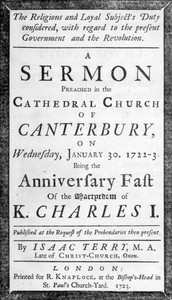
The religious and loyal subject's duty considered: with regard to the present Government and the Revolution A sermon preached in the Cathedral Church of Canterbury, on — Edition Insights
5
1
Project Gutenberg
2015
Church of England -- Sermons; Sermons, English -- 18th century; Government, Resistance to -- Religious aspects -- Christianity; Charles I, King of England, 1600-1649 -- Anniversaries, etc.; Bible. Proverbs XXIV, 21 -- Sermons
Readers of public-domain and historical texts
Project Gutenberg digital edition
en
Edition facts
Words: 10,041
Reading time: 44 min
Text sections: 2
Source:
Project Gutenberg record #48349
Isaac Terry's 1723 sermon, preached on the anniversary of Charles I's martyrdom, uses Proverbs 24:21 to argue that meddling with change leads to rebellion, tracing a step-by-step descent from discontent to regicide through vivid historical narrative.
Isaac Terry's 1723 sermon, preached in Canterbury Cathedral on the anniversary of Charles I's execution, takes as its text Proverbs 24:21: "My son, fear thou the Lord, and the King: and meddle not with them that are given to change." The sermon's structure is built around three injunctions—fear God, fear the king, avoid those given to change—but its most striking feature is the extended historical narrative that occupies the central section. Terry does not merely assert the dangers of political meddling; he reconstructs a causal chain from discontent to rebellion to regicide, using vivid language of gradual corruption. The sermon moves from general principle to specific history, then back to application, creating a rhetorical arc that mirrors the descent it describes.
Three Rules of Life
Terry opens by declaring that the verse contains "three rules of life, very necessary to be observed by all who would not be deemed enemies to the publick peace and tranquility." He announces he will treat each in order: fearing the Lord, fearing the King, and not meddling with those given to change. This tripartite structure gives the sermon a clear, almost catechetical framework. However, the surviving excerpt only develops the third rule in detail, suggesting that the sermon's weight falls on the warning against change. Terry's language here is measured and homiletic, but it quickly gives way to a more urgent tone as he moves into historical application.
The Artifice of Gradual Corruption
The central narrative describes how those who aimed at change "found it necessary to cover their real designs, under the specious pretences of remeding abuses, and securing the liberties of the people." Terry traces a step-by-step process: first, traducing the king and his ministers; then branding loyalists with "names and characters of reproach"; then breaking into open rebellion; and finally, after the breach had widened, revealing "their true designs against the person and government of the King." The language emphasizes gradual hardening: consciences become "perfectly insensible" through "long familiarity with disloyalty and treason." Terry insists that many who ultimately assisted the regicide would have been "struck with horror at the mention of it" years earlier, but were "artfully trailed on, step by step." This is not a static condemnation but a dynamic warning about moral descent.
Fruitless Protestations and Shared Guilt
Terry acknowledges that some who had been active in the war were "startl'd at the unprecedented proceedings against the person of the King" and expressed public dislike. But he dismisses these as "fruitless protestations" and "pitiful compensations" for the services they had rendered to the king's murderers. The guilt, he argues, extends beyond those immediately involved: it must be imputed "in a lower degree to those also, who made way for it, by the unwarrantable practices, which have been already mentioned." This extension of culpability is a key rhetorical move, broadening the sermon's admonition to include anyone who participates in the early stages of dissent. The historical example becomes a warning for the present congregation: "Their miscarriages are our admonitions."
The Anniversary Fast as Rhetorical Frame
The sermon is explicitly tied to the annual fast commemorating Charles I's martyrdom, a date that carries political and liturgical weight. Terry assumes his audience's shared abhorrence of the "execrable parricide," but immediately questions their sincerity: "unless we have been all this while in this holy place prevaricating with God and man, and adding a feigned humiliation to the number of our former provocations." This rhetorical move both unites the congregation in condemnation and challenges their authenticity. The fast itself becomes part of the sermon's argument: the annual repetition of mourning is meant to prevent the nation from repeating the sin. Terry's use of the occasion is not merely ceremonial; it structures the sermon's urgency and its call to vigilance against the same gradual corruption that led to the regicide.
Readers should attend to how Terry uses the anniversary setting to create a sense of immediate moral danger. The sermon does not simply condemn past events; it insists that the same patterns of speech and action are present dangers. The recurring image of being "trailed on, step by step" gives the sermon a psychological dimension, warning that small compromises lead to irreversible consequences. Terry's careful reconstruction of the rebellion's stages rewards close reading for its rhetorical strategy as much as its political theology.
Reader reflection
Your personal reading reflection
Build a private reading journal entry for this title.
Your progress
0
/
10
2
Did this book hold your interest?
3
Is this a title you would suggest to others?
4
How easy was the book to follow?
5
How did the reading compare with what you expected?
6
How much did the book move you?
7
How understandable was the text?
8
Would you start a conversation about this book?
9
What did this book teach you most?
10