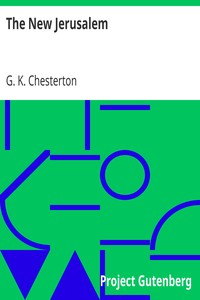
The New Jerusalem by G. K. Chesterton

(2 User reviews)   3323
Chesterton, G. K. (Gilbert Keith), 1874-1936 Chesterton, G. K. (Gilbert Keith), 1874-1936
English
Hey, you know how we sometimes wonder why certain cities just feel different? G.K. Chesterton's 'The New Jerusalem' is his wild, funny, and deeply personal travelogue from 1920. It's not a guidebook. It's Chesterton trying to figure out why Jerusalem, of all places, feels like the center of the world's biggest argument. He wanders the streets, talks to everyone, and tries to untangle the knot of history, faith, and politics that makes this city so electric and so troubled. It's like watching a brilliant friend think out loud on a life-changing trip.
Share

Read "The New Jerusalem by G. K. Chesterton" Online

This book is available in the public domain. Start reading the digital edition below.

START READING FULL BOOK
Instant Access    Mobile Friendly

Book Preview

A short preview of the book’s content is shown below to give you an idea of its style and themes.

and are now reproduced in a book as they were published in the newspaper. The only exception refers to the last chapter on Zionism; and even there the book only reverts to the original note-book. A difference of opinion, which divided the writer of the book from the politics of the newspaper, prevented the complete publication of that chapter in that place. I recognise that any expurgated form of it would have falsified the proportions of my attempt to do justice in a very difficult problem; but on re-reading even my own attempt in extenso, I am far from satisfied that the proper proportions are kept. I wrote these first impressions in Palestine, where everybody recognises the Jew as something quite distinct from the Englishman or the European; and where his unpopularity even moved me in the direction of his defence. But I admit it was something of a shock to return to a conventional atmosphere, in which that unpopularity is still actually denied or described as mere persecution. It was more of a shock to realise that this most obscurantist of all types of obscurantism is still sometimes regarded as a sort of liberalism. To talk of the Jews always as the oppressed and never as the oppressors is simply absurd; it is as if men pleaded for reasonable help for exiled French aristocrats or ruined Irish landlords, and forgot that the French and Irish peasants had any wrongs at all. Moreover, the Jews in the West do not seem so much concerned to ask, as I have done however tentatively here, whether a larger and less local colonial development might really transfer the bulk of Israel to a more independent basis, as simply to demand that Jews shall continue to control other nations as well as their own. It might be worth while for England to take risks to settle the Jewish problem; but not to take risks merely to unsettle the Arab problem, and leave the Jewish problem unsolved. For the rest, there must under the circumstances be only too many mistakes; the historical conjectures, for they can be no more, are founded on authorities sufficiently recognised for me to be permitted to trust them; but I have never pretended to the knowledge necessary to check them. I am aware that there are many disputed points; as for instance the connection of Gerard, the fiery Templar, with the English town of Bideford. I am also aware that some are sensitive about the spelling of words; and the very proof-readers will sometimes revolt and turn Mahomet into Mohammed. Upon this point, however, I am unrepentant; for I never could see the point of altering a form with historic and even heroic fame in our own language, for the sake of reproducing by an arrangement of our letters something that is really written in quite different letters, and probably pronounced with quite a different accent. In speaking of the great prophet I am therefore resolved to call him Mahomet; and am prepared, on further provocation, to call him Mahound. G. K. C. CONTENTS CHAPTER I THE WAY OF THE CITIES CHAPTER II THE WAY OF THE DESERT CHAPTER III THE GATES OF THE CITY CHAPTER IV THE PHILOSOPHY OF SIGHT-SEEING CHAPTER V THE STREETS OF THE CITY CHAPTER VI THE GROUPS OF THE CITY CHAPTER VII THE SHADOW OF THE PROBLEM CHAPTER VIII THE OTHER SIDE OF THE DESERT CHAPTER IX THE BATTLE WITH THE DRAGON CHAPTER X THE ENDLESS EMPIRE CHAPTER XI THE MEANING OF THE CRUSADE CHAPTER XII THE FALL OF CHIVALRY CHAPTER XIII THE PROBLEM OF...

This is a limited preview. Download the book to read the full content.

So, what's this book about? In 1919, Chesterton traveled to Palestine and wrote about it. But forget dry history. 'The New Jerusalem' is his notebook from the edge of the world. He describes the landscape, the people, and the sheer weight of history pressing down on every stone. The 'story' is his journey of discovery, trying to understand the clash of civilizations and faiths that was shaping the modern Middle East after World War I. He meets British officials, Zionist pioneers, and Arab locals, listening to all sides while wrestling with his own Christian perspective.

Why You Should Read It

You should read it because Chesterton is a fantastic companion. His wit is like a flashlight in a dark room—he points out absurdities and profound truths with equal charm. He doesn't give easy answers. Instead, he shows you the complexity of a place where every rock tells three different stories. It’s a book about belonging, conflict, and the search for home, themes that feel painfully relevant today. You get history, theology, and social commentary, all filtered through one man's wonderfully curious and humane mind.

Final Verdict

Perfect for travelers who love ideas more than souvenirs, and for anyone tired of simple headlines about the Middle East. If you enjoy writers who ask big questions with a twinkle in their eye (think a more philosophical Bill Bryson), you'll find a friend in this book. It's a century-old journey that speaks directly to our current moment.


🟢 License Information

This text is dedicated to the public domain. Distribute this work to help spread literacy.

Emily Martin
8 months ago

From the very first page, the clarity of the writing makes this accessible. I couldn't put it down.

Dorothy Thomas
1 year ago

This book was worth my time since it creates a vivid world that you simply do not want to leave. A true masterpiece.
5
5 out of 5 (2 User reviews )

Add a Review

Your Rating *
There are no comments for this eBook.
You must log in to post a comment.
Log in


Related eBooks