
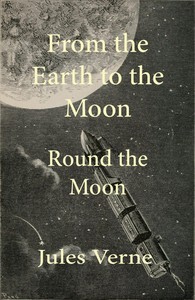
From the Earth to the Moon; and, Round the Moon by Jules Verne

(5 User reviews)   3359
Verne, Jules, 1828-1905 Verne, Jules, 1828-1905
English
Hey, if you think space travel is a modern idea, think again! Jules Verne wrote this wild adventure in 1865, decades before airplanes were even invented. It's about a bunch of American Civil War veterans who get bored after the war and decide to shoot a giant cannonball at the moon. Yes, you read that right. The whole book is their crazy plan to build the world's biggest gun, put three men inside a projectile, and fire themselves into space. It's a hilarious, surprisingly scientific, and totally audacious race against physics and common sense. You'll be grinning at their sheer nerve the whole time.
Share

Read "From the Earth to the Moon; and, Round the Moon by Jules Verne" Online

This book is available in the public domain. Start reading the digital edition below.

START READING FULL BOOK
Instant Access    Mobile Friendly

Book Preview

A short preview of the book’s content is shown below to give you an idea of its style and themes.

CHAPTER I. From Twenty Minutes Past Ten to Forty-Seven Minutes Past Ten P. M. CHAPTER II. The First Half Hour CHAPTER III. Their Place of Shelter CHAPTER IV. A Little Algebra CHAPTER V. The Cold of Space CHAPTER VI. Question and Answer CHAPTER VII. A Moment of Intoxication CHAPTER VIII.At Seventy-Eight Thousand Five Hundred and Fourteen Leagues CHAPTER IX. The Consequences of A Deviation CHAPTER X. The Observers of the Moon CHAPTER XI. Fancy and Reality CHAPTER XII. Orographic Details CHAPTER XIII. Lunar Landscapes CHAPTER XIV. The Night of Three Hundred and Fifty-Four Hours and A Half CHAPTER XV. Hyperbola or Parabola CHAPTER XVI. The Southern Hemisphere CHAPTER XVII. Tycho CHAPTER XVIII. Grave Questions CHAPTER XIX. A Struggle Against the Impossible CHAPTER XX. The Soundings of the Susquehanna CHAPTER XXI. J. T. Maston Recalled CHAPTER XXII. Recovered From the Sea CHAPTER XXIII. The End FROM THE EARTH TO THE MOON CHAPTER I. THE GUN CLUB During the War of the Rebellion, a new and influential club was established in the city of Baltimore in the State of Maryland. It is well known with what energy the taste for military matters became developed among that nation of ship-owners, shopkeepers, and mechanics. Simple tradesmen jumped their counters to become extemporized captains, colonels, and generals, without having ever passed the School of Instruction at West Point; nevertheless; they quickly rivaled their compeers of the old continent, and, like them, carried off victories by dint of lavish expenditure in ammunition, money, and men. But the point in which the Americans singularly distanced the Europeans was in the science of _gunnery_. Not, indeed, that their weapons retained a higher degree of perfection than theirs, but that they exhibited unheard-of dimensions, and consequently attained hitherto unheard-of ranges. In point of grazing, plunging, oblique, or enfilading, or point-blank firing, the English, French, and Prussians have nothing to learn; but their cannon, howitzers, and mortars are mere pocket-pistols compared with the formidable engines of the American artillery. This fact need surprise no one. The Yankees, the first mechanicians in the world, are engineers—just as the Italians are musicians and the Germans metaphysicians—by right of birth. Nothing is more natural, therefore, than to perceive them applying their audacious ingenuity to the science of gunnery. Witness the marvels of Parrott, Dahlgren, and Rodman. The Armstrong, Palliser, and Beaulieu guns were compelled to bow before their transatlantic rivals. Now when an American has an idea, he directly seeks a second American to share it. If there be three, they elect a president and two secretaries. Given _four_, they name a keeper of records, and the office is ready for work; _five_, they convene a general meeting, and the club is fully constituted. So things were managed in Baltimore. The inventor of a new cannon associated himself with the caster and the borer. Thus was formed the nucleus of the “Gun Club.” In a single month after its formation it numbered 1,833 effective members and 30,565 corresponding members. One condition was imposed as a _sine quâ non_ upon every candidate for admission into the association, and that was the condition of having designed, or (more or less) perfected a cannon; or, in default of a cannon, at least a firearm of some description. It may, however, be mentioned that mere inventors of revolvers, fire-shooting carbines, and similar small arms, met with little consideration. Artillerists always commanded the chief place of favor. The estimation in which these gentlemen were held, according to one of the most scientific exponents of the Gun Club, was “proportional to the masses of their guns, and in the...

This is a limited preview. Download the book to read the full content.

The Story

After the American Civil War, the members of the Baltimore Gun Club are restless. Their president, the bold Impey Barbicane, proposes an outrageous project: to build a colossal cannon and launch a projectile to the Moon. The world goes crazy with the idea. After immense scientific calculation (Verne did his homework!) and engineering, the giant Columbiad is built in Florida. But then, a rival shows up: the French adventurer Michel Ardan. He doesn't just want to send a bullet—he wants to ride in it. The mission transforms into a manned voyage, and three brave (or foolish?) souls seal themselves into a specially designed aluminum capsule for the ultimate shot into the unknown.

Why You Should Read It

What blew me away was Verne's imagination. He mixes real math and 19th-century science with pure, joyful adventure. Reading it, you feel the excitement and global frenzy he imagines. The characters are wonderful—especially Michel Ardan, the life of the party who brings humor and heart to a deadly serious mission. It's not just a technical manual; it's about human ambition, friendship, and the irresistible pull of the horizon. You can see the direct line from this book to every sci-fi story and real space mission that followed.

Final Verdict

Perfect for anyone who loves classic adventure, the origins of science fiction, or just a fantastic story told with wit and wonder. If you enjoy stories where clever people try to do the impossible, and you don't mind a few old-fashioned details, you'll be hooked. It’s a thrilling reminder that the dream of reaching the stars is older than we think.


🟢 Community Domain

This title is part of the public domain archive. Distribute this work to help spread literacy.

Charles Sanchez
3 months ago

Great digital experience compared to other versions.

Michael King
1 year ago

Perfect.

Logan Garcia
11 months ago

High quality edition, very readable.

Andrew Scott
1 year ago

Simply put, the arguments are well-supported by credible references. Definitely a 5-star read.

Mason Williams
6 months ago

Great digital experience compared to other versions.

4.5
4.5 out of 5 (5 User reviews )

Add a Review

Your Rating *
There are no comments for this eBook.
You must log in to post a comment.
Log in


Related eBooks