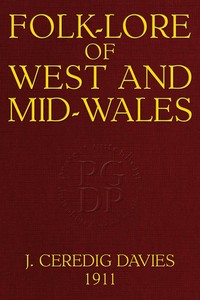
Folk-Lore of West and Mid-Wales by Jonathan Ceredig Davies

(7 User reviews)   3483
Davies, Jonathan Ceredig, 1859-1932 Davies, Jonathan Ceredig, 1859-1932
English
Hey, have you ever wondered about the real stories behind those Welsh place names or old family superstitions? This book is like finding your great-grandmother's secret diary, but for an entire culture. Jonathan Ceredig Davies spent years in the late 1800s talking to people, writing down the tales they told by the fireside. It's not a dry history book—it's a collection of ghost stories, fairy encounters, cures for warts, and explanations for why you shouldn't whistle at night. The real mystery here is how much of this vivid, strange world has simply vanished. It feels urgent, like he's racing to save these stories before the modern world makes everyone forget. It’s a direct line to a way of thinking that’s almost completely gone.
Share

Read "Folk-Lore of West and Mid-Wales by Jonathan Ceredig Davies" Online

This book is available in the public domain. Start reading the digital edition below.

START READING FULL BOOK
Instant Access    Mobile Friendly

Book Preview

A short preview of the book’s content is shown below to give you an idea of its style and themes.

Missionary enterprise, history and prospects of Western Australia, etc. In 1901, Mr. Ceredig Davies came back to live in his native country, Wales. In Cardiganshire, and the centre of Wales, generally, there still remains a great mass of unrecorded Celtic Folk Lore, Tradition, and Custom. Thus it was suggested that if Mr. Ceredig Davies wished again to write a book--the material for a valuable one lay at his door if he cared to undertake it. His accurate knowledge of Welsh gave him great facility for the work. He took up the idea, and this book is the result of his labours. The main object has been to collect "verbatim," and render the Welsh idiom into English as nearly as possible these old stories still told of times gone by. The book is in no way written to prove, or disprove, any of the numerous theories and speculations regarding the origin of the Celtic Race, its Religion or its Traditions. The fundamental object has been to commit to writing what still remains of the unwritten Welsh Folk Lore, before it is forgotten, and this is rapidly becoming the case. The subjects are divided on the same lines as most of the books on Highland and Irish Folk Lore, so that the student will find little trouble in tracing the resemblance, or otherwise, of the Folk Lore in Wales with that of the two sister countries. ALICE AMHERST. Plas Amherst, Harlech, North Wales, 1911. INTRODUCTION. Welsh folk-lore is almost inexhaustible, and of great importance to the historian and others. Indeed, without a knowledge of the past traditions, customs and superstitions of the people, the history of a country is not complete. In this book I deal chiefly with the three counties of Cardiganshire, Carmarthenshire, and Pembrokeshire, technically known in the present day as "West Wales"; but as I have introduced so many things from the counties bordering on Cardigan and Carmarthen, such as Montgomery, Radnor, Brecon, etc., I thought proper that the work should be entitled, "The Folk-Lore of West and Mid-Wales." Although I have been for some years abroad, in Patagonia, and Australia, yet I know almost every county in my native land; and there is hardly a spot in the three counties of Carmarthen, Cardigan, and Pembroke that I have not visited during the last nine years, gathering materials for this book from old people and others who were interested in such subject, spending three or four months in some districts. All this took considerable time and trouble, not to mention of the expenses in going about; but I generally walked much, especially in the remote country districts, but I feel I have rescued from oblivion things which are dying out, and many things which have died out already. I have written very fully concerning the old Welsh Wedding and Funeral Customs, and obtained most interesting account of them from aged persons. The "Bidder's Song," by Daniel Ddu, which first appeared in the "Cambrian Briton" 1822, is of special interest. Mrs. Loxdale, of Castle Hill, showed me a fine silver cup which had been presented to this celebrated poet. I have also a chapter on Fairies; but as I found that Fairy Lore has almost died out in those districts which I visited, and the traditions concerning them already recorded, I was obliged to extract much of my information on this subject from books, though I found a few new fairy stories in Cardiganshire. But as to my chapters about Witches, Wizards, Death Omens, I am indebted for almost all my information to old men and old women whom I...

This is a limited preview. Download the book to read the full content.

Forget dusty archives. Folk-Lore of West and Mid-Wales is a snapshot of living memory. Jonathan Ceredig Davies didn't just read old books; he walked the lanes and knocked on doors. He asked farmers, elders, and storytellers about everything: the fairies in the local hill, the proper way to ward off evil spirits, and the meaning behind peculiar village traditions. The book is organized by topic—ghosts, customs, superstitions, medicine—but it reads like a series of conversations. You get the raw material of belief, straight from the people who held it.

Why You Should Read It

This book has a quiet magic. It’s not trying to convince you that fairies are real. Instead, it shows you how deeply these ideas were woven into daily life. A story about a phantom funeral explains a bend in the road. A charm for healing a sprain uses everyday items. It makes you see the landscape differently. Every hill, well, and old tree had a story attached to it, a layer of meaning that guided how people lived. Davies writes with respect, never making his sources seem silly. Their beliefs were practical, a toolkit for navigating a mysterious world.

Final Verdict

Perfect for anyone with roots in Wales, or for readers who love social history and real-world magic. If you enjoy shows like Folklore or podcasts about strange tales, this is the original source material. It’s also a book for slow reading—dip into a few pages at a time. Some sections are simple lists of beliefs, which can be fascinating in their repetition. It’s a vital, humble record. It preserves voices that would otherwise be silent, and for that alone, it’s worth your time.


🏛️ Legacy Content

This book is widely considered to be in the public domain. Enjoy reading and sharing without restrictions.

Kevin Wright
1 year ago

I had low expectations initially, however the plot twists are genuinely surprising. A valuable addition to my collection.

David Brown
2 months ago

As someone who reads a lot, it challenges the reader's perspective in an intellectual way. A valuable addition to my collection.

5
5 out of 5 (7 User reviews )

Add a Review

Your Rating *
There are no comments for this eBook.
You must log in to post a comment.
Log in


Related eBooks