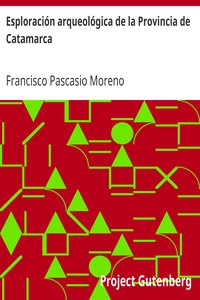
Esploración arqueológica de la Provincia de Catamarca by Francisco Pascasio Moreno

(2 User reviews)   4261
Moreno, Francisco Pascasio, 1852-1919 Moreno, Francisco Pascasio, 1852-1919
Spanish
Hey, have you ever wondered what it was like to be the first person to officially document ancient ruins? That’s exactly what this book feels like. It’s not a novel—it’s the real, raw field notes of Francisco Pascasio Moreno, a young explorer, as he treks through the remote Catamarca region of Argentina in the late 1800s. There are no Indiana Jones-style villains, but the conflict is real: it’s a race against time, harsh landscapes, and limited resources to record archaeological sites before they’re lost or looted. Reading this is like finding a dusty, detailed diary from a forgotten expedition. It’s a direct line to the moment of discovery, full of wonder, frustration, and the sheer physical challenge of exploration. If you love the idea of primary sources and seeing history through the eyes of the person who was there, this is a fascinating, grounding read.
Share

Read "Esploración arqueológica de la Provincia de Catamarca by Francisco Pascasio Moreno" Online

This book is available in the public domain. Start reading the digital edition below.

START READING FULL BOOK
Instant Access    Mobile Friendly

Book Preview

A short preview of the book’s content is shown below to give you an idea of its style and themes.

grandes modificaciones, como lo indican los nuevos descubrimientos. Aun cuando en estos últimos cincuenta años se han agregado muchos nuevos elementos de investigacion sobre este pasado, á los que encontramos en las obras mas ó menos verídicas ó mas ó menos ingénuas ó interesadas, del tiempo de la conquista, fáltannos en la República Argentina monografías de cierta estension ó estudios que se aparten del «Diario» del viajero, y que á la manera de las investigaciones practicadas en los centros de civilizacion del mundo bíblico, detallen lo que son y contienen las viejas ruinas sud-americanas, rehaciendo así la historia de los pueblos que dejaron esos portentosos vestigios y el medio físico en que actuaron. Méjico, además de poseer de su gran pasado obras de largo aliento y fruto de pacientes esploraciones, acaba de publicar oficialmente un verdadero monumento monográfico sobre sus antigüedades. Puede estudiarse á Yucatan y á sus maravillosas ruinas en el Museo del Trocadero, en Paris, por todos los interesados en la vieja historia de América. Nicaragua, las regiones del Istmo, Nueva Granada, Venezuela, Ecuador, han sido pacientemente investigadas en estos últimos tiempos, y Estados-Unidos, Francia y Alemania sobre todo, ostentan en sus museos materiales para principiar á reconstruir el pasado de esos países americanos. Mas próximos á nosotros y mas ligados en el pasado que el presente con lo que es hoy República Argentina y cuyo estudio tiene por lo tanto mayor interés para nosotros, el Perú y Bolivia han tenido entre otros investigadores de sus misteriosas ruinas, quizá mas importantes para el conocimiento del mas remoto pasado de América, que Yucatan ó Méjico, á D'ORBIGNY, CASTELNAU, RIVERO, TSCHUDI, ANGRAND, MITRE, SQUIER, WIENER, STUBEL, WEISS y FALB. El primero, nos ha dado una buena série de observaciones sobre Tiahuanaco, pero disponiendo de reducidos elementos de consulta, ignorando los otros grandes vestigios de viejas sociedades de los valles centrales ó de la costa del Perú y los esparcidos en la República Argentina, con la única base de sus observaciones en la meseta del Lago Titicaca, se concretó á la descripcion de lo que había esplorado, considerando á esas ruinas como vestigios del arte aimará, anteriores á la dominacion incásica, dinastía que empieza, segun D'Orbigny, con la fundacion del Cuzco por Manco-Capac, salido del Titicaca en el siglo XI. Incurrió con esto, siguiendo á Garcilaso, en la creencia errónea de la modernidad de la dinastía, sin detenerse á pensar que es imposible que naciones como la Quichúa y la Aimará, que profesaban el culto de la tradicion, olvidaran tan pronto el esplendor de una civilizacion como la del Titicaca y sus inmediaciones, que debía todavía existir en la época de la aparicion de Manco-Capac, porque un legislador como éste no brota del desierto, ni que tal civilizacion se destruyera tan rápidamente que sus vestigios fueran considerados como antiguallas de tiempo desconocido por los mismos indígenas, al llegar los Españoles. Castelnau, que recorrió mayor estension de Bolivia y Perú que D'Orbigny, describió mas estensamente las mismas ruinas, pero sin adelantar nada sobre su orígen. Se ocupó con detalle de las ruinas del Cuzco, que considera incásicas, y entrando en consideraciones sobre la antigüedad de la civilizacion del Perú, que es «bien anterior á la especie de renacimiento á la cual los Incas dieron su nombre», se resolvió por el orígen semítico de los habitantes de América, y por el contacto con las civilizaciones del Mundo Antíguo, presentando interesantes analogías en apoyo de sus ideas, pero descuidando lo que mas debió investigar: las naciones que produjeron las construcciones gigantescas que admira. Rivero y Tschudi no las descuidaron, y fueron los primeros autores...

This is a limited preview. Download the book to read the full content.

This book is a direct transcript of Francisco Pascasio Moreno's official report from his 1875-76 expedition. Think of it as his official 'trip log' submitted to the Argentine government. He was only in his early twenties when he led this journey.

The Story

There isn't a traditional plot. Instead, you follow Moreno and his team as they travel through the challenging terrain of Catamarca. The 'story' is their progress from one location to the next. He meticulously describes the landscapes, the difficulties of travel (finding water, navigating mountains), and, most importantly, the ancient sites they find. He details ruins, burial grounds, pottery, and tools, often making sketches and taking measurements. The narrative tension comes from the physical hardship and the urgency of documenting everything accurately before moving on.

Why You Should Read It

What makes this special is its immediacy. This isn't a polished history book written decades later. You get Moreno's first impressions—his excitement at a new find, his theories about who built the sites, and his clear frustration with the damage caused by looters. You feel the dust and the exhaustion. It strips away romantic notions of exploration and shows the gritty, systematic work that real archaeology requires. It’s a powerful reminder that these 'ancient' sites were being rediscovered and saved in the not-so-distant past.

Final Verdict

This is a niche but rewarding read. It's perfect for history buffs and archaeology enthusiasts who want to go beyond summaries and get their hands on a primary source. It’s also great for anyone interested in the history of exploration or Argentina. If you prefer fast-paced narratives or character-driven stories, this might feel too technical. But if you've ever wanted to look over the shoulder of a 19th-century explorer at work, this book is your time machine.


🏛️ Copyright Free

You are viewing a work that belongs to the global public domain. Knowledge should be free and accessible.

Charles Gonzalez
1 year ago

Beautifully written.

Amanda Lewis
1 year ago

I had low expectations initially, however the narrative structure is incredibly compelling. Exactly what I needed.
4.5
4.5 out of 5 (2 User reviews )

Add a Review

Your Rating *
There are no comments for this eBook.
You must log in to post a comment.
Log in


Related eBooks